AI Research & AI Shopping Is Already Reality: How to Prepare Now

AI Research & AI Shopping Is Already Reality: How to Prepare Now

AI Research & AI Shopping Is Already Reality: How to Prepare Now

AI Research & AI Shopping Is Already Reality: How to Prepare Now

Information search and online shopping are changing. More and more customers no longer “Google” dozens of tabs — they ask an AI: what to buy, how much it costs, who to choose, where to order — and receive a ready-made answer with recommendations and links. This is known as GPT AI Research (AI gathers information and cites sources) and GPT AI Shopping (AI shows products and leads to a purchase). While most companies still operate by the old SEO rules, AI has already started changing search results — and those who prepare earlier will benefit.

What’s happening right now (and why it matters)

ChatGPT Shopping is already working. In spring 2025, OpenAI updated ChatGPT Search: for “shopping” queries, the assistant shows not a list of links, but several product cards (image, description, reviews, link to the seller). A storefront inside the chat — without classic ads (according to OpenAI). What does that mean? Recommendations are formed based on metadata (price, description, reviews/ratings), not on advertising budget. 🔗 Forbes. Key point: the era of “agentic” commerce. At the end of September 2025, OpenAI launched Instant Checkout — a purchase directly inside the conversation, without going to a website. For now, the feature is available in the U.S. and works with sellers on Etsy; next comes expansion, including Shopify, and the development of a “cart.” The technical foundation is the Agentic Commerce Protocol (ACP): a “commerce language” for AI agents to request product data, availability, and complete transactions.

How the rules of the game are changing

Search results become short. AI shows a few cards. If you/your product is not in that short list, for part of the audience you simply “don’t exist.” The focus shifts from keywords to product/service data. If “classic SEO” used to be about headlines and text, in the ChatGPT ecosystem it’s critical how well characteristics, price, and availability are described — and whether there is confirmation (reviews, independent reviews). AI traffic may be smaller, but it’s “hotter.” A Seer Interactive study shows: conversion from ChatGPT traffic is around 15.9% versus about 1.8% for Google organic search (in their case study).

GPT vs Google: what’s the difference (very briefly)

Parameter Google GPT / AI Shopping
What does the user see? a list of links a short storefront with a few cards
How do you win? SEO + advertising data quality + trust + structure
Main factor rankings/CTR relevance + metadata + reviews/sources
What should a business do? “promote itself” “become understandable to AI” and prepare data/site
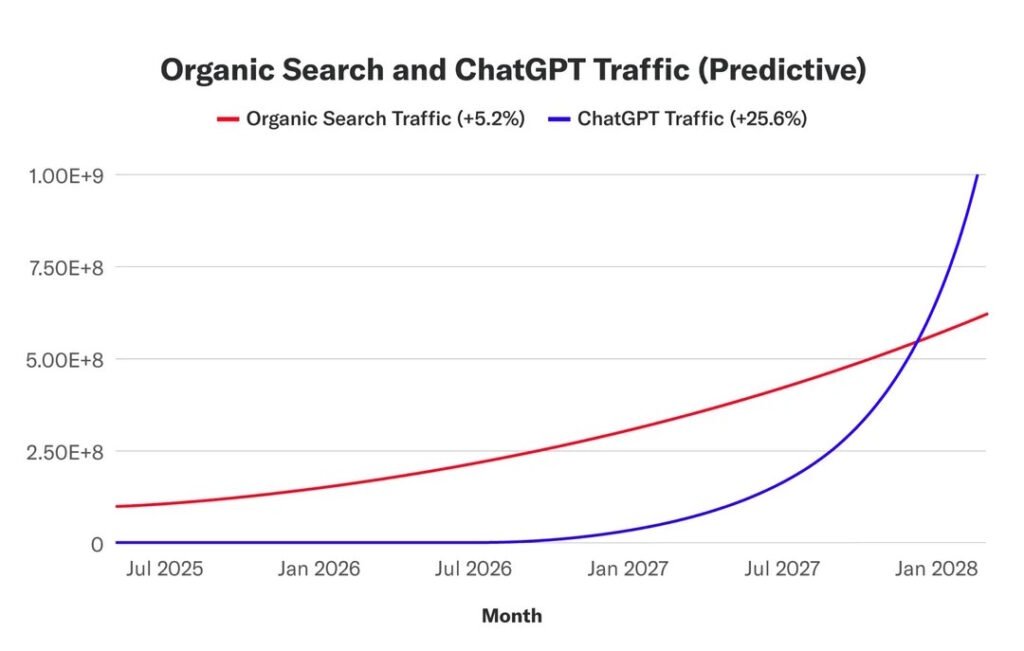
Illustrative forecast if growth rates remain the same: referral traffic from ChatGPT (+25.6% per month) vs organic search (+5.2%). This is an extrapolation based on publicly discussed Siege Media data/estimates; actual dynamics may differ due to seasonality and changes in user behavior. 🔗 Reddit.

What you can do right now on your own, without additional costs — a basic checklist

These steps are already enough to build a foundation for rapid changes in the near future.

1) Check whether AI “sees” you — and whether it can link to your website

Start with a simple test directly in an AI (ChatGPT/Perplexity, etc.). For example, ask:
  • “Find the official website of the company <name> in Latvia and list the key pages (services/contacts/prices). Provide links to sources.”
  • “What services does <name> provide, and on which pages is this confirmed?”
If AI cannot find your site, mixes up pages, or cannot provide correct links, it is often not an “AI error” but a signal that the site lacks structure and technical accessibility for crawlers.

2) A quick technical check (why Google is still relevant here)

Yes, it’s an “old” method — but it remains the fastest way to understand how the site is read by crawlers in general. Type in Google: site:yourdomain.lv (for example, site:hitexis.com) — and see which pages are in the index and how they are displayed. If you are not in the index, or the result looks strange/truncated/“junk,” then the site may have:
  • weak structure and internal linking,
  • issues in sitemap.xml,
  • restrictions in robots.txt,
  • canonical/duplicate problems,
  • important content loading only via JS and poorly visible to crawlers.
In that case, AI crawlers (including those that help form answers and product/service selections) will likely face the same obstacles and won’t be able to “read” your site correctly.

3) Make pages “answer-oriented”

AI more often uses content that is written clearly. On service/category pages, add blocks like:
  • what you do and who it is for;
  • steps, timelines, geography (Riga/Latvia/…), terms/guarantees;
  • FAQ (5–10 questions);
  • examples/case studies;
  • reviews;
  • links to social media;
  • specific or starting prices;
  • business hours and delivery, returns, warranty.

4) Strengthen trust

About the company, SIA details, contacts, address/service area, return/warranty/delivery policy — these are not “formalities,” but trust signals.

5) Add basic structured data (Schema)

This is the main “bridge” between the website and the AI ecosystem:
  • for services: Organization/Business + Services + FAQ;
  • for e-commerce: Product/Offer (price, currency, availability).
Those will win whose product/service data is described so that AI can correctly “assemble” a product or service card.

6) Configure bot access consciously (robots.txt)

Some AI systems come to websites with their own crawlers. It’s important to decide what you allow them to scan and what you don’t (it depends on content and strategy).

What happens next?

Instant Checkout is already launched in the U.S.; currently it supports purchasing a single item, and next come a cart, expansion of merchants and regions, including Shopify. At the same time, the market is changing quickly: 🔗 Reddit provides a forecast that by 2028 traffic from AI agents may surpass classic search — and this changes the role of marketplaces, SEO, and advertising. In January 2026, OpenAI also announced testing ads in ChatGPT as a separate block, but that does not change the fact that data quality and trust remain key factors for organic recommendations.

How SIA HITEXIS can help

Based on our observations, many sites are already starting to receive traffic from chatgpt.com and other AI platforms, but technically most are not ready for it: GPT AI does not understand exactly what you sell/offer, what the terms are, and where the trust proof is. (This is exactly the situation where there are “few slots in the results,” and you want to be on the list.) The SIA HITEXIS team has extensive experience in developing and modernizing projects, continues training, tracks changes in traffic sources, and follows new developments in the AI ecosystem. We can “bring a site back to life”: put the structure in order, prepare key pages for AI citations and AI storefronts, implement basic markup, and build a foundation for GPT AI Research and AI Shopping. If you want to understand how ready your site is and what will deliver the biggest impact first — you can book a consultation with SIA HITEXIS.

AI Research & AI Shopping Is Already Reality: How to Prepare Now

AI Research & AI Shopping Is Already Reality: How to Prepare Now

Information search and online shopping are changing. More and more customers no longer “Google” dozens of tabs — they ask an AI: what to buy, how much it costs, who to choose, where to order — and receive a ready-made answer with recommendations and links. This is known as GPT AI Research (AI gathers information and cites sources) and GPT AI Shopping (AI shows products and leads to a purchase). While most companies still operate by the old SEO rules, AI has already started changing search results — and those who prepare earlier will benefit.

What’s happening right now (and why it matters)

ChatGPT Shopping is already working. In spring 2025, OpenAI updated ChatGPT Search: for “shopping” queries, the assistant shows not a list of links, but several product cards (image, description, reviews, link to the seller). A storefront inside the chat — without classic ads (according to OpenAI). What does that mean? Recommendations are formed based on metadata (price, description, reviews/ratings), not on advertising budget. 🔗 Forbes. Key point: the era of “agentic” commerce. At the end of September 2025, OpenAI launched Instant Checkout — a purchase directly inside the conversation, without going to a website. For now, the feature is available in the U.S. and works with sellers on Etsy; next comes expansion, including Shopify, and the development of a “cart.” The technical foundation is the Agentic Commerce Protocol (ACP): a “commerce language” for AI agents to request product data, availability, and complete transactions.

How the rules of the game are changing

Search results become short. AI shows a few cards. If you/your product is not in that short list, for part of the audience you simply “don’t exist.” The focus shifts from keywords to product/service data. If “classic SEO” used to be about headlines and text, in the ChatGPT ecosystem it’s critical how well characteristics, price, and availability are described — and whether there is confirmation (reviews, independent reviews). AI traffic may be smaller, but it’s “hotter.” A Seer Interactive study shows: conversion from ChatGPT traffic is around 15.9% versus about 1.8% for Google organic search (in their case study).

GPT vs Google: what’s the difference (very briefly)

Parameter Google GPT / AI Shopping
What does the user see? a list of links a short storefront with a few cards
How do you win? SEO + advertising data quality + trust + structure
Main factor rankings/CTR relevance + metadata + reviews/sources
What should a business do? “promote itself” “become understandable to AI” and prepare data/site
Illustrative forecast if growth rates remain the same: referral traffic from ChatGPT (+25.6% per month) vs organic search (+5.2%). This is an extrapolation based on publicly discussed Siege Media data/estimates; actual dynamics may differ due to seasonality and changes in user behavior. 🔗 Reddit.

What you can do right now on your own, without additional costs — a basic checklist

These steps are already enough to build a foundation for rapid changes in the near future.

1) Check whether AI “sees” you — and whether it can link to your website

Start with a simple test directly in an AI (ChatGPT/Perplexity, etc.). For example, ask:
  • “Find the official website of the company <name> in Latvia and list the key pages (services/contacts/prices). Provide links to sources.”
  • “What services does <name> provide, and on which pages is this confirmed?”
If AI cannot find your site, mixes up pages, or cannot provide correct links, it is often not an “AI error” but a signal that the site lacks structure and technical accessibility for crawlers.

2) A quick technical check (why Google is still relevant here)

Yes, it’s an “old” method — but it remains the fastest way to understand how the site is read by crawlers in general. Type in Google: site:yourdomain.lv (for example, site:hitexis.com) — and see which pages are in the index and how they are displayed. If you are not in the index, or the result looks strange/truncated/“junk,” then the site may have:
  • weak structure and internal linking,
  • issues in sitemap.xml,
  • restrictions in robots.txt,
  • canonical/duplicate problems,
  • important content loading only via JS and poorly visible to crawlers.
In that case, AI crawlers (including those that help form answers and product/service selections) will likely face the same obstacles and won’t be able to “read” your site correctly.

3) Make pages “answer-oriented”

AI more often uses content that is written clearly. On service/category pages, add blocks like:
  • what you do and who it is for;
  • steps, timelines, geography (Riga/Latvia/…), terms/guarantees;
  • FAQ (5–10 questions);
  • examples/case studies;
  • reviews;
  • links to social media;
  • specific or starting prices;
  • business hours and delivery, returns, warranty.

4) Strengthen trust

About the company, SIA details, contacts, address/service area, return/warranty/delivery policy — these are not “formalities,” but trust signals.

5) Add basic structured data (Schema)

This is the main “bridge” between the website and the AI ecosystem:
  • for services: Organization/Business + Services + FAQ;
  • for e-commerce: Product/Offer (price, currency, availability).
Those will win whose product/service data is described so that AI can correctly “assemble” a product or service card.

6) Configure bot access consciously (robots.txt)

Some AI systems come to websites with their own crawlers. It’s important to decide what you allow them to scan and what you don’t (it depends on content and strategy).

What happens next?

Instant Checkout is already launched in the U.S.; currently it supports purchasing a single item, and next come a cart, expansion of merchants and regions, including Shopify. At the same time, the market is changing quickly: 🔗 Reddit provides a forecast that by 2028 traffic from AI agents may surpass classic search — and this changes the role of marketplaces, SEO, and advertising. In January 2026, OpenAI also announced testing ads in ChatGPT as a separate block, but that does not change the fact that data quality and trust remain key factors for organic recommendations.

How SIA HITEXIS can help

Based on our observations, many sites are already starting to receive traffic from chatgpt.com and other AI platforms, but technically most are not ready for it: GPT AI does not understand exactly what you sell/offer, what the terms are, and where the trust proof is. (This is exactly the situation where there are “few slots in the results,” and you want to be on the list.) The SIA HITEXIS team has extensive experience in developing and modernizing projects, continues training, tracks changes in traffic sources, and follows new developments in the AI ecosystem. We can “bring a site back to life”: put the structure in order, prepare key pages for AI citations and AI storefronts, implement basic markup, and build a foundation for GPT AI Research and AI Shopping. If you want to understand how ready your site is and what will deliver the biggest impact first — you can book a consultation with SIA HITEXIS.
Let’s start the conversation!