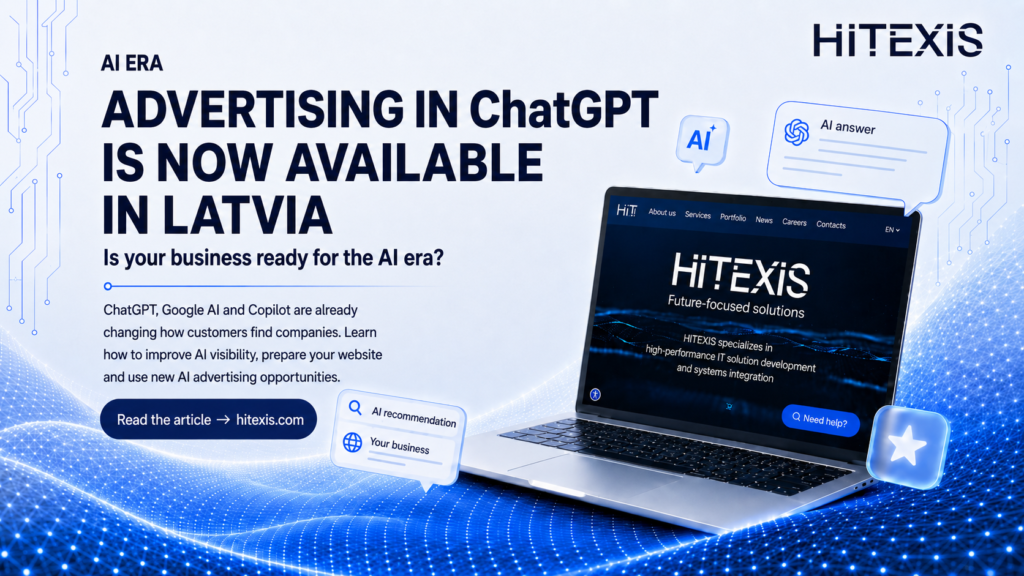
As of August 31, 2026, ChatGPT Ads are available in Latvia
This is one of the most important new AI opportunities for businesses in Latvia.
As of August 31, 2026, self-service access to ChatGPT Ads through Ads Manager is available in Latvia. Businesses can now directly use ChatGPT as a new advertising channel for their products and services.
This matters because ChatGPT is becoming more than a place where people search for information: it is also becoming a new advertising environment for businesses.
Ads can reach users while they are exploring options, comparing solutions and moving toward a decision.
The model is different from traditional advertising built primarily around search queries and individual keywords.
ChatGPT Ads can consider the intent and context of the current conversation together with signals such as the landing page and advertising copy. Instead of relying on only a few keywords, users can describe what they are looking for in detail, creating a richer context for relevant advertising.
There is, however, an important distinction:
advertising does not buy a position inside ChatGPT’s organic answers.
OpenAI keeps ads separate from ChatGPT responses. Sponsored placements are clearly identified, and advertisers cannot pay to influence which businesses ChatGPT recommends in its answer.
Google and Microsoft are developing similar advertising opportunities across their AI experiences. Google can display advertising around AI Overviews and, in selected markets, inside the AI Overview itself, while Microsoft continues expanding advertising across Copilot experiences. Availability varies by market and advertising product.
A new category is emerging:
AI-native advertising.
But advertising is only one part of the change. Until recently, one of the most important digital marketing questions was simple:
“Where does our website rank on Google?”
Today, that is no longer enough.
People are increasingly moving away from opening ten websites and manually comparing every option. Instead, they ask ChatGPT, Google AI, Copilot and other AI systems complete questions:
“Which company should I choose to develop my website?”
“Who provides this service in Latvia?”
“Which solution would be best for my company?”
“Compare these three providers and recommend the most suitable one.”
A significant part of the decision-making process can now happen before the potential customer ever reaches a traditional search results page.
This creates a new question for every company:
Is your business truly ready for the AI era?
Having a modern website is no longer enough.
Businesses also need to understand:
whether AI can discover their website;
whether it can access and read the content;
whether AI understands what the company actually does;
whether it can identify its services, products and operating markets;
whether its pages are trustworthy and useful enough to be referenced;
whether the brand appears in AI-generated answers;
and whether its marketing strategy is prepared for AI-native advertising.
“Can AI see my website?” is now a real technical question
An AI system does not experience a website in exactly the same way a human visitor does.
A beautiful hero section, animations and impressive visual design do not automatically tell an AI system who your company is or what it provides.
The website must first be technically discoverable.
OpenAI, for example, uses OAI-SearchBot to discover content that may appear in ChatGPT Search. If OAI-SearchBot is blocked through robots.txt, the ability for ChatGPT to access and surface that content may be limited. GPTBot, which relates to potential model training, is a separate crawler and should not be confused with ChatGPT search visibility.
Google follows a similar principle. To be eligible to appear as a source in AI Overviews or AI Mode, a page must first be indexable and eligible for Google Search. Google explicitly states that there is no special AI schema or secret markup required to appear in its generative AI experiences.
In other words, AI visibility starts with a technically sound website.
Being accessible to AI does not mean being selected by AI
Discovery is only the first step.
The next question is whether an AI system understands your content well enough to use it as part of an answer.
Information structure becomes extremely important.
AI can more accurately understand a website when it clearly explains:
who the company is;
what services it provides;
who those services are for;
where the company operates;
what technologies and expertise it has;
which problems it solves;
which projects it has completed;
and what evidence supports its expertise.
Clear headings, well-structured service pages, genuine case studies, FAQs, technical documentation, structured data and current information all make it easier for search engines and AI systems to interpret a website correctly.
Microsoft already recommends improving content clarity and structure, supporting claims with examples and data, keeping information current and reducing ambiguity across text, images and other formats to improve visibility in AI-generated answers.
The objective is therefore not to “write for robots”.
The goal is to create information that can be understood equally well by a human, a search engine and an AI system.
AI visibility can now be measured
One of the most important developments of 2026 is that AI visibility is becoming measurable.
Microsoft has introduced AI Performance in Bing Webmaster Tools, allowing website owners to see which pages are being cited across Microsoft Copilot and other supported AI experiences, how frequently citations occur and which grounding queries lead AI systems to their content.
Google has also introduced dedicated generative AI visibility reporting in Search Console. As of August 31, 2026, these insights have been rolled out worldwide, giving website owners greater visibility into how their pages appear across AI Overviews, AI Mode and other generative Search experiences.
Traffic arriving through ChatGPT Search can also be identified in analytics because OpenAI adds the utm_source=chatgpt.com parameter to referral URLs.
This means companies increasingly need to look beyond traditional SEO metrics.
Alongside rankings, impressions and organic clicks, we now have:
AI citations, AI visibility and AI referral traffic.
The next step: websites must also become AI-agent ready
The change goes beyond search.
AI systems are increasingly moving from answering questions to helping users perform actions: comparing offers, finding products, completing forms or progressing towards a purchase.
This makes the technical quality of the interface part of an AI-ready architecture.
OpenAI, for example, recommends properly implemented ARIA roles, labels and states for interactive elements such as buttons, menus and forms. These practices improve accessibility while also helping AI agents understand what interface elements do and how they can be used.
Until now, we primarily designed websites for people.
Increasingly, they will also need to be understandable and usable by AI agents.
What should businesses check today?
1. Is your website properly indexed?
Google, Bing and relevant AI crawlers need to be able to access important pages.
2. Does AI understand your business?
Services, products, expertise and operating markets should be clearly described.
3. Does your website contain information worth citing?
Case studies, expert articles, original research, comparisons, useful answers and real data become increasingly valuable.
4. Are technical SEO and structured data implemented correctly?
They are not a magic GEO shortcut, but they help systems understand your content accurately.
5. Are you measuring AI visibility?
ChatGPT referrals, Google AI visibility, Bing AI citations and resulting conversions should become part of your analytics.
6. Is your interface AI-agent ready?
Forms, navigation, catalogues and core actions need a clear technical structure.
7. Is AI part of your advertising strategy?
For businesses in Latvia, ChatGPT Ads can already become part of the marketing mix.
The AI era is not coming. It has already started.
The question is no longer whether AI will replace traditional search.
Users are already using both.
They search on Google, ask ChatGPT, compare alternatives through Copilot, explore AI Overviews and then decide which business to contact.
A modern digital strategy therefore increasingly needs to combine:
SEO + AI visibility + AI-ready architecture + analytics + AI advertising.
Businesses that build this infrastructure now have the opportunity to gain an advantage as AI search becomes a standard part of the customer journey.
Can AI see your business?
HITEXIS helps companies assess and improve how prepared their digital presence is for the new generation of search — from technical indexing, SEO and data structure to AI visibility, analytics, AI-agent readiness and emerging advertising channels.
Your website may look excellent to a human. The next question is: how well does artificial intelligence understand it?